Sarmad Kashani — The Man Who Refused to Finish a Prayer
19 Apr 2026 · 5 min read
Sarmad Kashani. You've probably never heard this name.
He was born Jewish in Persia sometime around 1590. Educated. Merchant family. Came to India in the 1600s chasing trade.
He never went back.
Somewhere between arriving in Sindh and wandering into Delhi, something shifted. He fell into Sufi philosophy so deeply that he gave away everything he owned. Stopped wearing clothes. Let his hair grow. Stopped cutting his nails. Just wandered, city to city, writing poetry in Persian.
A French physician named François Bernier who was travelling through the Mughal empire at the time actually saw him and wrote about this naked faqir wandering the streets of Delhi like it was the most natural thing in the world.
Neither Jew, nor Muslim, nor Hindu
Sarmad was born Jewish. At some point he nominally converted to Islam. But he himself used to warn Jews not to convert. And in his own poetry he wrote:
Persian —
Hast dar baatin-e man — Kaaba, o but-khaana, o dair.Inside me lives the mosque, the temple, the synagogue. I am the Jew, the Muslim, the Brahmin.
Scholars have called him the “Jewish-Yogi-Sufi Courtier of the Mughals” — which is possibly the most accurate description of any human being ever written.
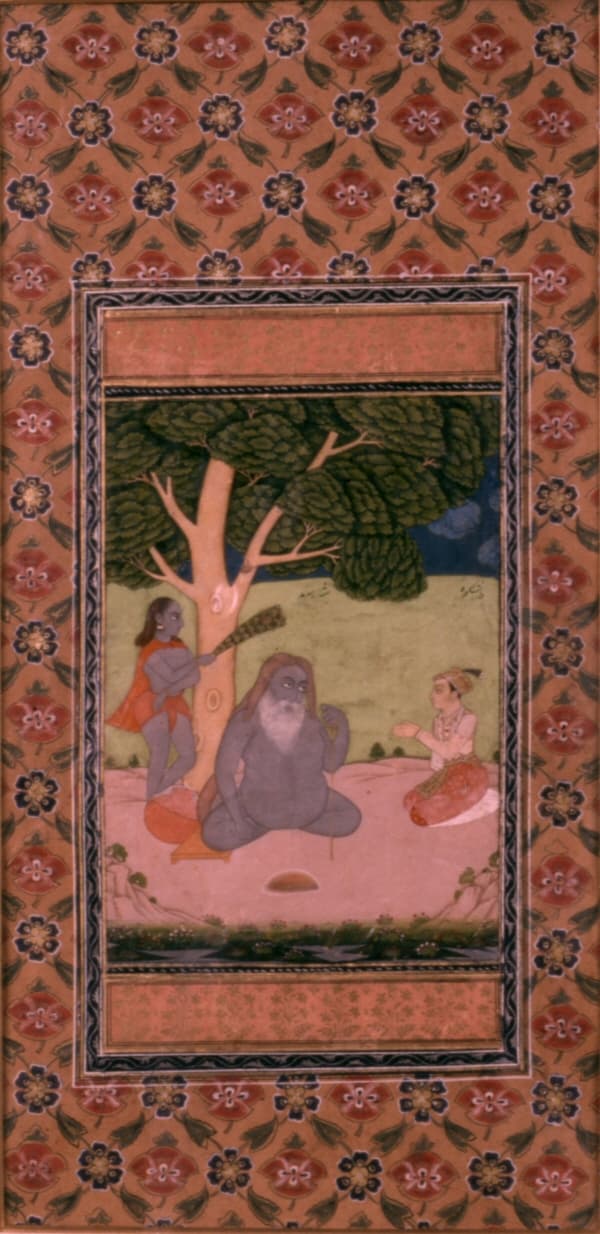
He became close to Dara Shikoh, the Mughal crown prince known for his interest in Sufi philosophy and Hindu-Muslim synthesis. Dara became his disciple. Which meant that when Aurangzeb killed Dara and took the throne, Sarmad had already made a powerful enemy.
The Half Prayer
The Islamic declaration of faith, the Kalima, goes: La ilaha illallah. There is no God, but Allah.
Sarmad would only ever say the first half. La ilaha. There is no God. And stop.
Aurangzeb had him arrested. His clerics asked Sarmad why he refused to complete it.
He said — I am still absorbed with the negative part. Why should I tell a lie?
That answer sealed his death sentence. They beheaded him in 1661, right outside the Jama Masjid in Delhi. A court chronicler named Ali Khan-Razi was present at the execution and recorded that Sarmad recited poetry as he walked to his death.
The Tomb
His dargah (his shrine) is still there. Lal Kuan, Matia Mahal, Old Delhi. Right next to the Jama Masjid.
The man who refused to belong to any religion. Buried in the shadow of one.
People from every faith still come to visit.
A Note on Responsibility
Everything in this piece comes from documented historical sources. The one claim worth flagging — “possibly the first Jew Aurangzeb killed”— is an inference, not a documented fact. What is documented is that he was executed by Aurangzeb's order in 1661, on charges of atheism and unorthodox religious practice.
The execution quote, “Why should I tell a lie?”, is confirmed by multiple primary sources including Aurangzeb's own court chronicler.
References
Primary Sources
- Bernier, François (1916). Travels in the Mogul Empire AD 1656–1668. Oxford University Press. — French physician who personally witnessed Sarmad; documents his wandering life.
- Ali Khan-Razi— Court chronicler of Aurangzeb. Present at the execution. Recorded Sarmad's final verses.
- The Rubaiyat of Sarmad. Translated by Syeda Sayidain Hameed (1991). Indian Council for Cultural Relations. Full PDF
- Singer, I. & Gray, L.H. Sarmad, Mohammed Sa'id. The Jewish Encyclopedia. jewishencyclopedia.com
Image
- Single Leaf of Shah Sarmad and Prince Dara Shikoh — Unknown Indian artist, ca. 1650–1658. The Walters Art Museum, Baltimore (Accession W.912). Public domain. Wikimedia Commons
Location
Sarmad Shaheed Dargah — Lal Kuan, Matia Mahal, Old Delhi (next to Jama Masjid).
Part of the series — India and its Poets